High-speed beverage production increases output, but it also increases the impact of small deviations. This article explains why inspection, pasteurisation and process control need to be integrated throughout the line.
We brew, can and bottle your beer without limits.
Safeguarding quality and compliance in high-speed beverage production
Safeguarding quality and compliance in high-speed beverage production
The demand for beer, non-alcoholic drinks and other innovative beverages continues to grow. For many brands, that is a positive evolution. But as volumes increase, so does the pressure on production, filling and quality control.
Producing more is not the biggest challenge. Producing more without errors, without quality loss and without compliance risks is where it becomes critical.
At high production speeds, there is less room for correction. A wrong label, a missing cap, an unreadable code or an issue during pasteurisation can quickly affect a large number of products. That is why quality control in modern beverage production should not be treated as a final check at the end of the line. It needs to be built into the entire process.
Why high-speed production requires more than speed
A fast production line must first of all be a stable production line. Especially with bottles and cans, small deviations can have major consequences.
Think of:
- incorrect or poorly positioned labels
- missing or incorrectly placed caps or lids
- filling level deviations
- unreadable or missing product codes
- issues with sealing, packaging or traceability
At lower volumes, many checks can still be carried out manually. At higher volumes, that becomes much harder. Not because people are less accurate, but because the line simply moves faster than manual control can realistically follow.
That is why automated inspection systems are not a luxury. They are an essential part of a professional production environment.
Automated inspection: consistent control without slowing down the line
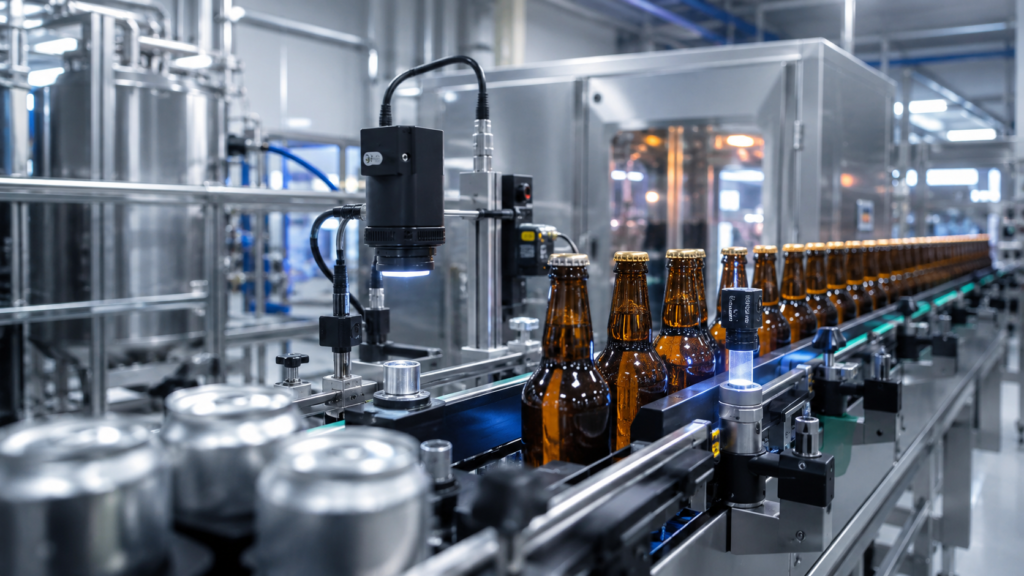
In high-speed production, every product needs to pass the same level of control. Automated inspection helps detect deviations early, before products leave the brewery.
This may include checks such as:
- presence and position of labels
- correct placement of caps, crown caps or lids
- readability of batch codes and best-before dates
- filling level control
- detection of visible packaging defects
The main benefit is not only speed. The real value is consistency. An automated system checks in the same way, again and again, without fatigue or interpretation differences.
For brands outsourcing the production of their beer or non-alcoholic beverage, this matters. Their reputation depends not only on the recipe, but on every single product that reaches retail, hospitality or export markets.
High-speed pasteurisation: protecting safety and shelf life
For many packaged beverages, pasteurisation plays an important role in microbiological stability and shelf life. This becomes especially important when products are distributed widely, exported internationally or stored for longer periods.
A modern tunnel pasteuriser makes it possible to treat large volumes in a controlled way. Temperature, residence time and product type must be carefully aligned.
This is important for:
- traditional beers
- non-alcoholic beers
- flavoured beverages
- still or lightly carbonated drinks
- products in bottles or cans
The goal is clear: improve microbiological safety without putting unnecessary pressure on taste. This balance is particularly delicate for non-alcoholic beers, because the low or absent alcohol content offers less natural protection than traditional beer.
That is why this topic also connects with the non-alcoholic brewing hub. Not as the main subject, but as an important link: brands producing non-alcoholic beverages at scale need to pay close attention to stability, food safety and process control.
Fewer errors, less waste, lower risk
Quality control at high speed is not just a technical matter. It is also an organisational advantage.
When inspection, registration and process monitoring are properly integrated, teams spend less time on rechecks, corrections and uncertainty. They can focus more on process supervision, recipe development, planning and improvement.
This directly benefits production:
- less product loss
- less repacking
- less downtime
- lower recall risk
- more predictable volumes
- more confidence for customers and distributors
For brands, this is essential. A production error does not only cost money. It can also damage trust. And in the beverage industry, trust is harder to rebuild than a production line is to restart.
Flexibility still matters
High speed should not mean less flexibility. The market increasingly demands variety: different formats, different volumes, seasonal products, non-alcoholic alternatives, private label products and test launches.
A modern contract brewery therefore needs to switch between formats and product types without losing control.
Think of:
- bottles and cans
- slim, sleek and standard can formats
- alcoholic and non-alcoholic products
- small test volumes and larger production runs
- traditional beers and innovative beverages
This flexibility makes contract brewing valuable for brands that want to grow without investing heavily in additional lines, inspection systems, pasteurisation capacity or laboratory support.
Why an experienced contract brewery makes the difference
High-speed production brings many factors together: recipe, raw materials, filling, packaging, pasteurisation, traceability, quality control and planning.
Managing all of that internally requires more than machinery. It requires people, experience, procedures and control systems.
An experienced partner such as Belgian Contract Brewery helps brands keep that complexity under control. BCB combines production capacity with laboratory support, quality control and experience across different product types, including non-alcoholic beers and custom beverages. Existing BCB content already highlights physicochemical and microbiological analyses, quality checks throughout brewing, fermentation and filling, and specific attention to can quality control. This article builds on that foundation from the specific angle of high-speed production.
Conclusion: speed requires control
Producing more only creates value when quality scales with it.
In high-speed production, quality control is not a final checkpoint. It becomes a structural part of the complete production process. Automated inspection, controlled pasteurisation, flexible filling and clear procedures help brands grow without putting their reputation at risk.
For breweries and beverage brands looking to scale up, absorb peak volumes or launch new products, working with an experienced contract brewery is therefore more than a practical solution. It is a strategic way to safeguard quality, compliance and continuity.
Bron: Belgian Contract Brewery.
FAQ
1) Why is quality control more critical at high production speeds?
Because there is less room for correction, and a single issue can quickly affect a large number of products.
2) What does automated inspection typically check?
For example label presence and position, cap or lid placement, code readability, filling level and visible packaging defects.
3) Why is pasteurisation especially delicate for non-alcoholic beers?
Because low or absent alcohol content offers less natural protection than traditional beer.